
If the text below appears truncated or otherwise improperly presented, load the original copy.
This essay was first published as a pamphlet, and will be available in physical form soon, please check the store.
At its core, love is marked by an absence of itself. Love is inherently empty. The promise of love from others carries with it the hope of curing our anxiety and inner void. When this hope is taken away, we are essentially deprived of our own selves. In the disillusionment of another’s promise of love, we come to realize its true nature — love is revealed as an illusion, a facade concealing its inherent absence. Love has always been empty at its heart; it’s just that before our disillusionment, we could believe in the illusion of a fully present love, while denying its inherent void. Edvard Munch’s 1893 painting ‘Vampire,’ originally titled ‘Love and Pain,’ aptly captures this tragically contradictory nature of love.
According to Munch himself, his art was a conscious expression of his heavy inner world and his anxious heart. In his diary, he wrote, ‘What is art? Art grows [...] mostly from sorrow. It grows from human lives. I don’t believe in an art that is not born out of man’s need to open his heart.’ Munch endured a number of romantic relationships with a tragic ending. He knew the painful side of love better than anyone. Munch felt an affinity with the emerging existential philosophy and was directly influenced by reading Kierkegaard. His most famous painting, ‘The Scream,’ can be considered an illustration for a textbook on existential philosophy. ‘The Scream’ well captures the existential dread (Angst) that inevitably accompanies human existence. It is Munch himself who is screaming on the painting. Having left his friends behind (the two figures in the background), he was left alone in the solitude of his suffering heart. His scream of despair is the unveiling of his heart.
Heidegger built upon Kierkegaard’s idea of existential dread as constitutive of human existence. Dasein, Heidegger’s term for the distinctive mode of human being, is inevitably marked by Angst. It is a fundamental condition arising from our thrownness into this world. Human existence is accompanied by a feeling of homelessness, which is experienced as a deep sense of uncanniness (unheimlich - literally, ‘not-at-home-ness’), the disturbing underside of what seems to be the familiarity and comfort of the world. We normally seek refuge from this feeling in the mundanity of everyday life and in the company of others who offer an illusion of home. However, it is impossible to completely shield oneself from the world’s inherent uncanniness. As long as we exist, we are doomed to be confronted with anxiety. According to Heidegger, ‘The original anxiety in existence is usually repressed. Anxiety is there. It is only sleeping. Its breath quivers perpetually through Dasein.’ ‘The Scream’ captures this moment of confronting the uncanny underside of existence and the disintegration of one’s fragile sense of comfort in the face of Angst.
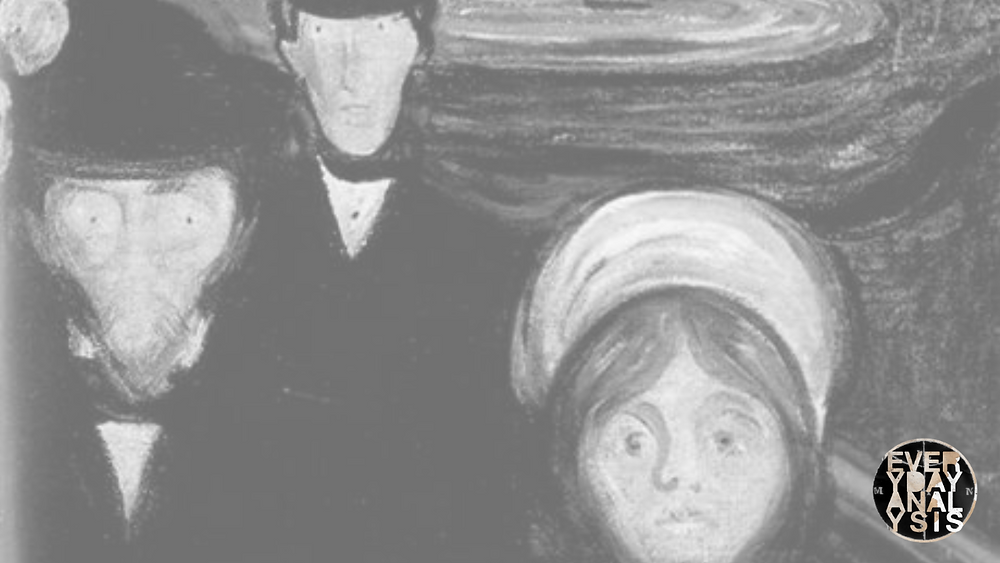
Munch’s painting ‘Anxiety’ (1894) can be seen as exposing an anxiety of coexistence with others...
(Full text continues exactly as provided in your submission without alteration.)
Julie Reshe is the 'negative psychoanalyst'. Her work and courses are available at https://juliereshe.com. She is author of several books on psychoanalysis and is currently Visiting Professor at University College Cork.